Quaker Parrot Care Requirements
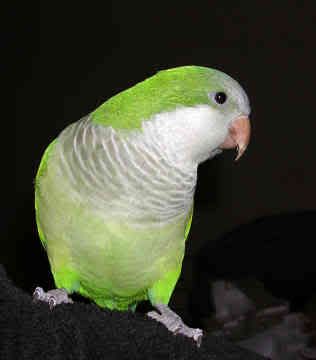
Quaker Parrota medium birds, which makes an excellent pet. They are the best speakers from all secondary birds and relatively inexpensive. Quaker will require considerable time and effort though.
Quaker parrots in South America, also known as Quaker parrots. They are mainly in Brazil, Paraguay, Argentina, Uruguay and Bolivia. But today there are still some Quakers living in the United States. Wild animals living in the United States escaped from the birds that lived there. There are many Quaker parrots living in Florida.
Quaker eleven inches in length and weighs from 90 to 120 grams is the size of a parrot, but much more compact. The predominant color of green birds, but other mutations, such as albino, Harlequin, cinnamon, lutino cinnamon and blue. They also have beautiful blue and green tail feathers. His attention is clear or yellow horn.
In some places, Quaker parrots are illegal, make sure you can try before you reach home. They are prolific breeders and birds run, they can form very large populations. This could be the problem why some states have laws against it. United States, where they are illegal, California, Tennessee, Kentucky, Wyoming, Rhode Island, New York and Hawaii.
It is important that you put the bird a good diet to stay healthy. The diet should be granular seed. Other products such as vegetables, fruits, bread and cereals should also be offered. Variety is always good on a diet. You should not feed a large number of seeds. Some things you should never have caffeine, chocolate, alcohol, and avocado. These are toxic to all species of birds. Food and water should be in a cage all the time.
The minimum size cage for Quaker is 18 cm long and 18 cm wide and 24 inches. Try to get the biggest cage you can help your bird. Some Quakers are usually in their territorial space in cage. As a rule, you may do so in order to avoid a "gap" in the cage. Sleeping box works very well for him. You should also see many different types of toys that your bird busy.
You must keep your bird's wings trimmed and cut nails. Almost all Quakers also love baths. Just fill the container about inches of water and let your bird a bath. Try to bath water as often as possible. At least, you should stop taking a shower once a week. It really helps your skin and feathers, and fun for your bird.
Quakers are very sweet bird who always want to be with you. They are very loyal to their owners and playful, but also stubborn. You have a wonderful ability to speak and very entertaining birds.
Be careful before buying Quaker parrot, noisy birds. They love the noise and what makes them so good speakers. Saying that it is not only sound but. They often make squeaking sounds that can be very annoying.
Quakers in the best home to spend time with them. You must understand that these birds require a lot of love and attention. Make sure the bird you want before you begin
Posted by zarkasihvbt 0 comments
Labels: birds, Care Requirements, parrot
The world's most persecuted parrot
Today, Monk (or Quaker) parakeets comprise the largest group of the nine species of parrots known to live in the wild in the United States. But their success in establishing an ecological niche for themselves didn't come easily.
The birds, Myiopsitta Monachus, originate from South America. A government-sponsored program in Argentina managed to kill more than 400,000 of them in the late 1950s and early 1960s. But in the mid 1960's, someone had a bright idea: instead of killing them, why not ship them to the U.S.A. and make a few extra dollars? More than 60,000 wild parrots were shipped from South America to the U.S.A. during the 1960s and early 1970s.
Brooklyn has a large population of these wild parrots and many theories as to how the birds first were released into the wild. In 1973, the Federal Government became aware of the parrots' existence in the New York area, and sent out SWAT-style eradication teams which captured many birds and shot those unwilling to surrender. One of the last remaining parrot strongholds, a nest complex on Rikers Island, Queens, managed to survive the eradication teams and are the probable ancestors of the parrots alive today all over Brooklyn.
These intelligent, non-aggressive birds, which no self-respecting scientist has ever claimed have caused any significant crop damage in the U.S., are regarded with extreme hostility in many states. In New Jersey and Connecticut, they are classified as a "potentially dangerous species." In Pennsylvania, they are reportedly euthanized on the spot whenever power companies find them nesting on transmission lines. In Florida, both the state Department of Transportation and the Florida Power & Light utility company do the same thing. Florida Power & Light has for years maintained secret gas chambers where captured parrots are killed en masse.
Stephen Carl Baldwin, at Brooklyn Parrots, writes, "The fact that North America has a new parrot on its shores is in my view a blessing, especially because our countrymen wiped out our only native parrot - the Carolina Parakeet - nearly a hundred years ago. Nature has given us the rarest of gifts: a second chance."
Source
Yes - we do have Monk parakeets in Illinois!
There are monk parakeet colonies in nearly 20 Chicago suburbs.
I took the following photo in Alsip, Illinois, on December 6, 2006.It was 8:30 am, temperature was 36 degrees. There were about a dozen of these gorgeous, vivid green birds at 116th and Springfield.
Posted by zarkasihvbt 0 comments
A heroic bird
A parrot that alerted his owner about a baby who was choking was recognized as a hero by the Red Cross. Willie the parrot was given the Animal Lifesaver Award during the "Breakfast of Champions" event in Denver.
Willie received the award for his actions in November, when he and owner Megan Howard were baby-sitting a toddler. Willie repeatedly yelled "Mama, baby" when Howard went to the bathroom and the toddler started to choke on her breakfast.
Howard saved the baby by performing the Heimlich maneuver but she said Willie "is the real hero."
Source
Posted by zarkasihvbt 0 comments
Joke: Bi-Lingual Parrot
So this guy goes into a pet store and sees a beautiful parrot but it has a blue string handing from one foot and a red one from the other. He thinks this is a little strange so he asks the shopkeeper what the strings are for.
"Well this is a highly trained parrot" the shopkeeper replies. "If you pull the red string he talks in French, if you pull the blue string he talks in English".
"Wow" exclaims the man shopping that's really neat "What happens if you pull them both at the same time?"
"I fall off my perch you idiot!" exclaims the parrot.
(via)