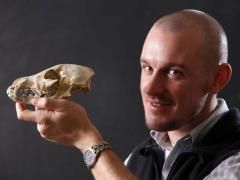
That's what researchers are saying after finding a bone fragment from what they are calling the earliest confirmed domesticated dog in the Americas.
University of Maine graduate student Samuel Belknap III came across the fragment while analyzing a dried-out sample of human waste unearthed in southwest Texas in the 1970s. A carbon-dating test put the age of the bone at 9,400 years, and a DNA analysis confirmed it came from a dog - not a wolf, coyote or fox, Belknap said.
Because it was found deep inside a pile of human excrement and was the characteristic orange-brown color that bone turns when it has passed through the digestive tract, the fragment provides the earliest direct evidence that dogs - besides being used for company, security and hunting - were eaten by humans and may even have been bred as a food source, he said.
Source
Dogs Were Man's Best Friend Even 9,400 Years Ago
The Watchful Sky
The head of Powell Lake was the scene of extensive logging in years past. In the heyday of MacMillan Bloedel, there was a large camp there to house loggers. When we visited last December, the old shops were still standing. When we arrived last week, everything was torn down and the ground bulldozed. The docks and log pens are still there, but for how much longer? One lone logging truck remained, a last testament to times gone by.
 A hike up the logging road towards the old camp was a sad reminder that times change.
 But the waters of the Daniels River flow on, filling Powell Lake as they have since the last ice age. I guess some things don't have to change. That's a good thing. -- Margy
Logging Upswing
 We live near Powell River in Coastal BC and logging is a very important part of our economy. In fact, the availability of good timber and lots of water for hydroelectric power made it an attractive location for the the paper mill that was built here in the early 1900's. You can learn about the history of timber and logging in our Forestry Museum at Willingdon Beach.
 The last several years have been difficult for forestry companies. There's the aftermath of the Canada vs. US softwood dispute, slowdown in new home construction, the recession and the high Canadian dollar for international trade. Up Powell Lake, much of the logging activity is conducted by Western Forest Products. From our cabin porch, we see them head up and down the lake with work boats and barges. I may not be awake at the early hour they go to work, but I can feel the wakes rock my cabin and the waves lap on the logs. That's much better than an alarm clock for sure.
 Each year different tracts are logged. This makes a patchwork on the hills and allows for trees to grow back at different rates. In the late 1990's, the hills north of the Hole in the Wall were logged. Trees there are now about ten feet tall and everything is green. Then last fall we got a notice on our cabin door that they would be logging this spring near our cabin. A full parking lot at the Shinglemill told us the time had come.
 Last month a large crew arrived and cut behind the cabins in the Hole and around the point towards the main lake. Because of the steep, rocky cliff behind us, our trees were spared. I know the rest will grow back in the years to come thanks to the hard work of tree planters and responsible logging companies. But at the same time, I'm glad mine still have a lease on life. -- Margy
Pool Man Canadian Style
 Do you have a swimming pool? I bet it needs periodic cleaning to keep it sparkling. Well, our "swimming pool" at the cabin is just the same. Only our "pool man" cleans it with a pike pole, not a broom.
When the lake level rises, wood and logs are released from the shorelines to float aimlessly across the surface. Wind and current push the debris slowly up and down the lake. Some works its way through our protective log boom and takes up residence in our "yard." This week Wayne went out to clean up the mess. He used our 14' pike pole to grab the logs and push them on their way. Pike poles are a traditional logging tool. Long aluminum (these days) poles are tipped with a two-pronged end. The sharp, straight end is used to push logs away. The curved spike is used to grab and pull logs. As you can see, some of the stove-sized lengths were hauled aboard the float to dry out. Later we'll saw them up for firewood. Maybe not a usual task for your pool man, but a handy addition out here in the bush. -- Margy
The Beachcombers are Back!
Since we moved to Powell River, Wayne and I've heard about a regional sitcom shot in Gibsons called The Beachcombers. It was a huge hit across the country and was Canada's longest running TV series. We tried to purchase a DVD of the shows, but they weren't available. All we could find were a few clips on YouTube.
Then lo and behold, there it was on Vision TV. It's currently running from Monday through Friday at 1:30 in the afternoon (4:30 ET). It may not be the best time, but maybe you can record it for later viewing. The show ran for 19 years and was about a log salvager (a beachcomber) who lived and worked around Gibsons BC. Prominent in the show was Molly's Reach, a restaurant on the Gibsons waterfront. You can still go there for a meal and see their boat the Persephone out front. You can even join their Facebook group.
Hope you get a chance to see this little bit of Coastal BC history (again)! -- Margy
A Float in Time
 I just finished reading A Float in Time by James Sirois (Hancock House, 1999). James Sirois was born in Ocean Falls, BC, in 1930. His parents divorced, so much of his upbringing was in his grandparents float logging camp along remote inlets on the northern BC coast. His grandfather, "Doc" Gildersleeve, ran a "gypo" logging operation from a floating base camp from 1916 until his death in 1956.
 Those early years were the heydey of logging along the BC coast. Crews were typically small, and included many family members. James was no exception. The book recounts his formative years in the logging camp and schooling (either by correspondence in the early years to high school in Ocean Falls).
The book is organized in a series of vignettes from events through the years, describing the beautiful remote setting and the hard life of a logger in the bush. Of course, I liked hearing about "working" float cabins. The glossary of logging terms at the beginning is excellent and the chronology at the end puts BC history in perspective. Mix in some historic family pictures and it's an excellent step back in time along the BC coast. After high school, James went to college at UBC and finally UW in Seattle to become an industrial designer. After his career in the States was over, he returned to Kimsquit on the Dean River where he lives in a cedar log cabin most of the year. As he says, "like a proverbial salmon returning to its place of origin." This book gets "two boomsticks up" from Margy. Pick it up at your local book store or online. -- Margy
Ancient Sea Water Trapped in Powell Lake
 One of our favorite places in the world is Powell Lake, BC. We love it so much we have a home floating on it's surface, a float cabin. While seeking information about Powell Lake, we discovered the results of an oceanographic study conducted by the University of British Columbia in 1962 and 1972. Oceanographic?
Powell Lake is one of the deepest lakes in BC with a recorded depth of 1,180 feet. It was created when glaciers scoured out its fjord shaped basin. If you travel up any of the inlets along the British Columbia coast, they look virtually the same as Powell Lake. The difference is they are filled with ocean water. In the case of Powell Lake,  after the glaciers retreated the surrounding land rose and sea water became trapped. Over the years, fresh water increased the depth of the lake, but did not mix completely with the heavier salt water at the bottom. At least, that was the hypothesis.
 What was discovered at the bottom of Powell Lake in 1962 was the oldest, about 10,000 years, trapped sea water to date. The water started becoming salty at about 400 feet and at the deepest levels was found to contain methane and hydrogen sulphide, which gives it a distinctive rotten egg odor. It contained no oxygen or life other than possible bacteria. This information sparked our imagination.
 First we tried to think of a way to built a deep water sample apparatus of our own. In the end, we went to a friend and borrowed a Kemmerer bottle designed for such a task. On October 21, 2006, Wayne and I conducted our own deep water drop (1,100 feet) in Powell Lake. We were so excited when we opened the Kemmerer bottle and discovered our own 10,000 year old water.
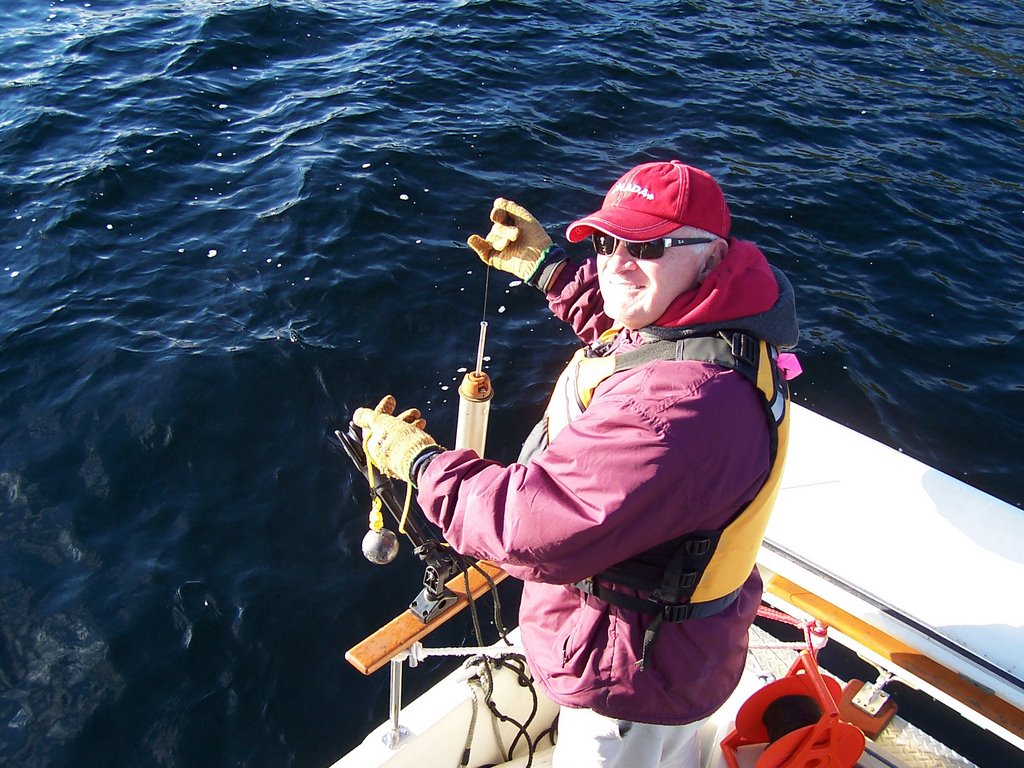 Yes, it was yellow and smelled of rotten eggs. We don't have the ability to conduct a chemical analysis, but a friend is helping with that as well. You just never know where your imagination can lead you. In our case, it led us back 10,000 years.
 Want more information about the drop? Read Up the Strait, the newest book in the Coastal BC Stories series by Wayne J. Lutz. It is available at www.PowellRiverBooks.com. -- Margy
You learn something new every day
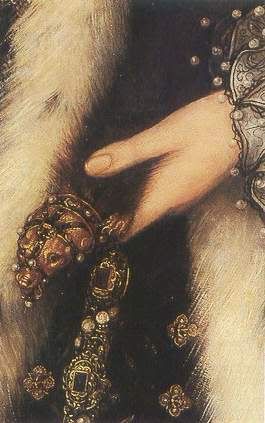
Zibellinis were a popular accessory item for noble men & ladies during the 15th and 16th centuries. A zibellino, from the Italian word for "sable", is the pelt of a sable or marten worn draped at the neck or hanging at the waist, or carried in the hand. The plural is zibellini.
Some zibellini were fitted with faces and paws of goldsmith's work with jeweled eyes and pearl earrings, while unadorned furs were also fashionable.
The traditional costume historian's term for this accessory, flea-fur, is from the German Flohpelz, coined by Wendelin Boeheim in 1894, who was the first to suggest that the furs were intended to attract fleas away from the body of the wearer. There is no historical evidence to support this unlikely claim. Italians simply called these accessories "zibellini", their word for sables, and speakers of other languages called them "martens", "sables" or "ermines" in their native tongues.
The fashion for carrying zibellini died out in the first years of the 17th century, although fox-pelts were worn in similar fashion in the 19th and 20th century. [wiki]
(via Scribal Terror)
Bridges by the BOMB Squad
In Powell River, BC, there's a famous group of men who give freely of themselves for the hiking community. They're called the BOMB Squad, short for Bloody Old Men's Brigade. Throughout the backcountry you will find countless trails, boardwalks and bridges they have constructed. According to their website, the squad began in 1987 with three retirees working to clear some of the older trails around Powell River. The group soon grew to seven men all in their sixties and seventies. As of last year, the number has increased to twenty-seven and the age range up to eighty. Thanks to consistent Thursday work day efforts, they have over 180 kilometres of trails and 60 structures to their credit. So if you go hiking in and around my town of Powell River, you will find lots of evidence of their handywork.
 For more about trails in the Powell River area check out these links:
Sunshine Coast Trail
Current Trail Conditions
Discover Powell River
thesunshinecoast.com
Trailpeak
I invite you to come to Powell River and try some of our wonderful trails and bridges. -- Margy
That's My World: The Powell River Paper Mill
 Whether you arrive in Powell River, BC, by land, air or sea, one of the first things you will see is the paper mill. The City of Powell River was born and grew up as a company town, and its present and future are still strongly linked to this major industry.
In the early 1900’s, entrepreneurial individuals explored Coastal BC looking for ways to profit from the abundant natural resources. Powell River is strategically located at the mouth of the Powell River and surrounded by lush forests. In 1909 the Minnesota based Brooks and Scanlon company purchased pulp leases and water rights to Powell Lake then incorporated as the Powell River Paper Company. Two paper machines soon grew to four, and in 1911 the company name was changed to the Powell River Company. Thus, by 1912, Powell River became the first newsprint-producing mill in Western Canada providing for the needs of growing Vancouver and Seattle newspapers.
 Over the last fifty years, ownership of the mill has changed several times. In 1959 the Powell River Company merged with MacMillian Bloedel to become MacMillan Bloedel & Powell River Ltd. In 1966 the name was shortened to MacMillan Bloedel Ltd. In 1998 the mill was sold to Pacifica Papers and then again in 2001 to Norske Skog Canada Ltd., soon to be called NorskeCanada followed by Catalyst Paper Corporation.
 Today, Catalyst’s paper mill in Powell River is no longer the largest in the world. Downsizing over the last 10 years has significantly decreased the workforce and production output. Powell River’s economy has diversified, but the mill is still a driving force in our community. I invite you to come visit and see how our small company town has grown to be the “Pearl of the Sunshine Coast.”
If you haven't seen it yet, check out my post on the mill's unique cement ship breakwater called the Hulks. For more information try these links about the history of Powell River.
Powell River Museum
Powell River My Home
Paper Pioneers
Catalyst
If you want to see more exciting places from around the world, go to the "That's My World" website. -- Margy
That's My World: The Hulks
Powell River in Coastal BC started as a company town for the Powell River Company. Brooks, Scanlon & Obrien joined forces to form the Powell River Company, western Canada's first pulp and paper mill. Powell River was selected for the location because of the close proximity of huge timber resources and a rushing river to be harnessed for power. The mill was started in 1908 and the first roll of paper was produced in 1912.
 The Hulks have been a common sight in Powell River since they were installed to form a protective floating breakwater for the mill's log pond in the late 1940's. They are all concrete ships originally built as transports for supplies in World Wars I and II. All ten are the last remaining representatives of their class of ships. The Peralta, holds the honor as THE last concrete ship remaining from World War I.
 In 2002 the mill, then owned by Pacifica Papers, eliminated it's pulping operations, but decided to keep the Hulks. They were reconfigured to make the pond smaller for barges of wood chips waiting for their turn in the mill.
 The waters off the Powell River coast are deep. It would be expensive, if not impossible, to build a traditional breakwater around the area. The concrete ships sit low in the water, thus providing protection from heavy wave action, even during storms. Huge concrete anchors and massive chains hold the ships in place. Occasionally, however, they must be reset due to the corrosive action of rust and the power of the sea.
 Here are some resources to find more history about the hulks:
The Powell River Museum
The Hulks: The Breakwater Ships of Powell River by John A Campbell
Shotcrete Repair of WWII Concrete Hulks
Pulp, Paper and People by Karen Southern and Peggy Bird
Powell River's First 50 Years by the Powell River News
TheSunshineCoast.com
And finally, a shot of the guardian of the pond and its historic Hulks. I invite you to put Powell River on your list of places to visit. If you are planning a trip to the 2010 Winter Olympics, we are only two ferry rides away. If you want to see more exciting places from around the world, go to the "That's My World" website. -- Margy
That's My World: Introducing Powell River, BC
This is my first "That's My World" post so I would like to introduce where my husband Wayne and I live, Powell River, British Columbia, Canada. Where is that, you ask? Just go up the coast about 145 kilometers (90 miles) from Vancouver to the "Sunshine Coast" and you'll discover the city of Powell River. Part of the charm (and sometimes frustration) is that it takes two ferry rides to get there. While technically Powell River is not on an island, it feels like island living because of the ferries.
 Powell River is a small town, with about 13,000 people living within the city boundaries and a total of 22,000 if you count the surrounding region. The people are welcoming, friendly and helpful. Even if you are a new arrival, it feels like coming home.
 The Powell River and nearby Powell Lake were named in honour of Israel Wood Powell, the superintendent of Indian Affairs for BC in the 1880s. The town of Powell River was started in 1910 as a papermill company town. Originally the mill was built and owned by the Powell River Company. It has gone through many hands and is now owned by Catalyst Paper. Once the largest paper mill in the world, it has downsized considerably in recent years.
 Powell River is no longer a company town. Homes are now privately owned and the Historic Townsite was designated a National Historic District by Parks and Monuments Canada in 1995. The Townsite is now one of four distinct communities (Cranberry, Westview, Townsite and Wildwood) that unified into the Corporation and District of Powell River in 1955. In 2005, the municipality became the City of Powell River.
 Wayne and I have fallen in love with the people and places in and around Powell River. Want to know more? Check the menu of topics in the side bar. Also, come back each week to discover a little bit more about Powell River.
View Larger Map
If you want to see more exciting places from around the world, go to the "That's My World" website. -- Margy
Backcountry Ruins
If you look carefully in the bush, you can find lots evidence of past inhabitants. They were loggers, shake block cutters and homesteaders. The Coastal BC rainforest quickly reclaims the land, but if you know where what to look for you can find all kinds of ruins and treasures. Our good friend John was walking along the shore at the head of Powell Lake and saw what looked like the remnants of a fence. A little farther inland he found the ruins of cabin.
 The residents were shake block cutters. You can read more about it here. The cabin was gone, but the woodstove, a rusted bread pan, the root cellar, an outhouse and a refuse dump were still there. In the dump there was an old boot, the metal head of a peavy they used to move logs, food cans and lots of Copenhagen cans, the guys must have really loved their snuff. There was also a can of boot grease. Everything a few guys would need for a life of hard work in the bush. -- Margy
Woodsmen of the West
 Coastal British Columbia is one of the few places that has a smaller population now than it did early in the 20th Century. All up and down the coast you could find remote logging camps, solitary hand-loggers, fishermen, canneries and settlers eking out a living in remote inlets. Then the canneries closed, support towns disappeared, logging practices changed and higher speed transportation altered the location of population centers.
 I love my new home in Coastal BC and enjoy reading about what life was like in the early days. Woodsmen of the West, written by M. Allerdale Grainger in 1908, is such a book. Grainger worked in the forestry industry as a chief of records, secretary of a royal commission on logging practices and chief forester. His book is fiction, but it's a realistic account about life in remote forests and camps.
The main character is Marty, an immigrant from England who has come to Canada to make his way. You follow him through the hotels, bars and hiring halls on Cordova Street in Vancouver, up the coast on the steamship Cassiar and to the Carter's remote logging camp in Coola Inlet. The book then switches to follow Carter's life and how he became a "Boss logger" and the owner of his own logging camp. It's a hard life for logger and boss alike. You get glimpses of the the pleasures and dangers of working in the forest, evenings around the wood stove in the bunkhouse, and annual trips to the city to drink and spend hard earned dollars.
If you are looking for a historical novel that is authentic, I highly recommend Woodsmen of the West. It can be purchased online at Amazon.com, Amazon.ca or Chapters.ca.
When I'm at the cabin, reading is one of my favourite pastimes. Do you have any suggestions for me? -- Margy
Beauty in the Bush
I live in a float cabin on Powell Lake in Coastal BC. We have lots of beautiful scenery and amazing places to explore.  Along the shore you can find beautiful rocks, driftwood and pieces of history. Each, in its own way, is beautiful.
 Tucked in the bush and along the shore you can find old logging camps. Many of the "shows" abandoned equipment in place. Steam donkeys, winches and other heavy equipment have rusted over the years to develop a beautiful patina.
 Vegetation takes over. First the undergrowth and mosses, then trees. This adds to the beauty and interest of these hidden pieces of history.
For my frequent readers, I'm heading back up the lake for a few days. Enjoy the rest of your weekend. -- Margy
Historical Fiddlehead Farm
 In the past, many people lived off-the-grid (actually, there was no grid) in Coastal BC. They found locations in the bush to grow fruits and vegetables, raise animals and make a living off the local resources, primarily fishing or lumber. In the 1960s, some of the remote locations attracted hippies. One such location was to become Fiddlehead Farm.
The history of the farm goes back to the days when people could stake a claim to vacant land through the pre-emption process. Most likely, it was farmed and the excess produce was taken to Powell River for sale. That way the land could support the family both directly and indirectly. By the 1960's, the farm was no longer occupied. An American "hippie" visitor to Canada was looking for a place to get back to the land and focus on a different sense of purpose (that's something that Wayne and I can identify with!). The leader was Mark Vonnegut and he wrote about his love for the land and his ultimate battle with schizophrenia in a book entitled The Eden Express.
Fiddlehead Farm the hostel grew out of this 60's generation. People from around the world came to the remote farm. It was a success for many years, but in 2002 it was again sold. It was subsequently logged and the buildings demolished. But Fiddlehead Farm is more than just a place, it is the memories of those who visited there over the years. Today, Fiddlehead Farm is a frequent destination for quad riders. The meadow with apple trees still remains and it makes a great lunch stop. In the fall, if you can get to the trees before the local bears, you can get some really tasty treats. As I sit under the trees on a warm sunny day, I can imagine all of the people who have lived and visited this little piece of eden.
Powell Lake is an exciting place. Read more about it in Up the Lake available online at www.PowellRiverBooks.com -- Margy


